
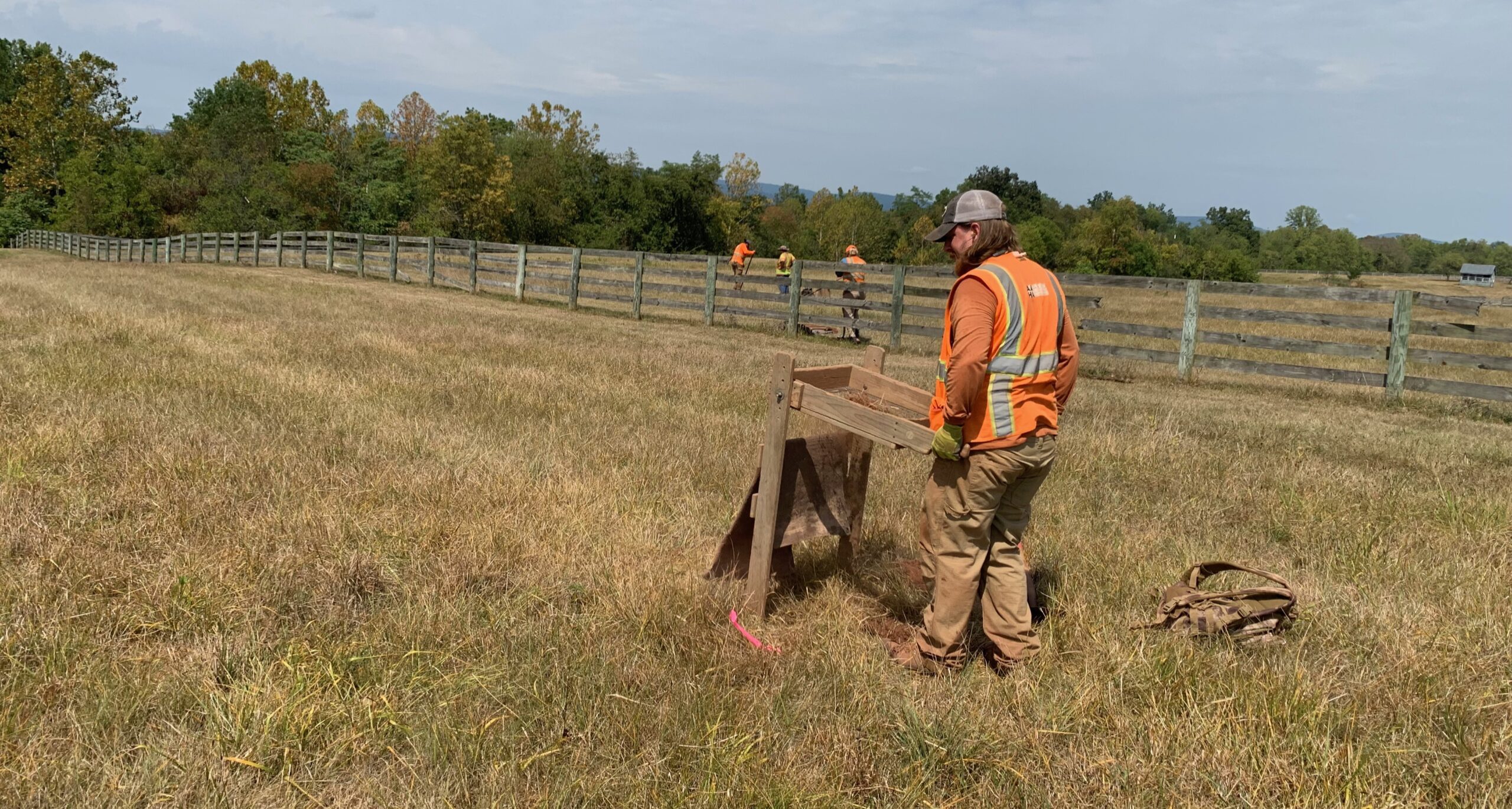
How do archaeologists recover artifacts? Screens! The technique is simple: place your dirt on a mesh screen and shake it! In a perfect world, the dirt falls through the mesh and your artifacts sit on top. In reality, silty or clay soils need to be pushed through the mesh, with clay and wet soils being particularly stubborn.
We generally use 1/4-inch mesh, though finer meshes like 1/16-inch or smaller may be used to recover very small artifacts like beads or seeds. The mesh size depends on the excavation Phase and what we are excavating. If we’re excavating a feature or if we’ve seen evidence of very small artifacts we might use a finer mesh. Why don’t we always use a finer mesh? Simple answer: efficiency. 1/16-inch mesh is four times finer than 1/4-inch and can take exponentially longer to process the same quantity of dirt.
Types of Screens
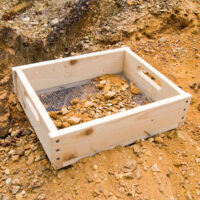
Box Screens: These are the simplest form of screen. They are made of a wooden frame fitted with a mesh screen. These are lightweight and often used on Phase I surveys as they are easy to carry between shovel test pits (STPs); however, they require more arm strength to hold up and shake around.
Photo courtesy of Forestry Suppliers
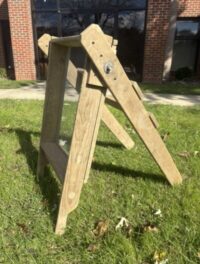
Rocking Screens: At AAHA, we prefer rocking screens. These screens have hinged legs so we can stand them up and shake them around. Even though they are much larger than box screens, they are still light enough to carry on a Phase I survey – just rest it on your shoulder and walk.
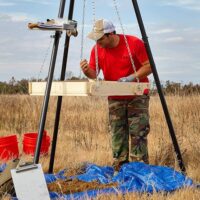
Tripod Screens: Tripod screens are stationary. They are essentially a box screen hanging from a tripod. These are most common on Phase II surveys and Phase III data recoveries when there is little walking involved. Like a rocking screen, the tripods allow you to shake the soil through.
Photo courtesy of Forestry Suppliers
